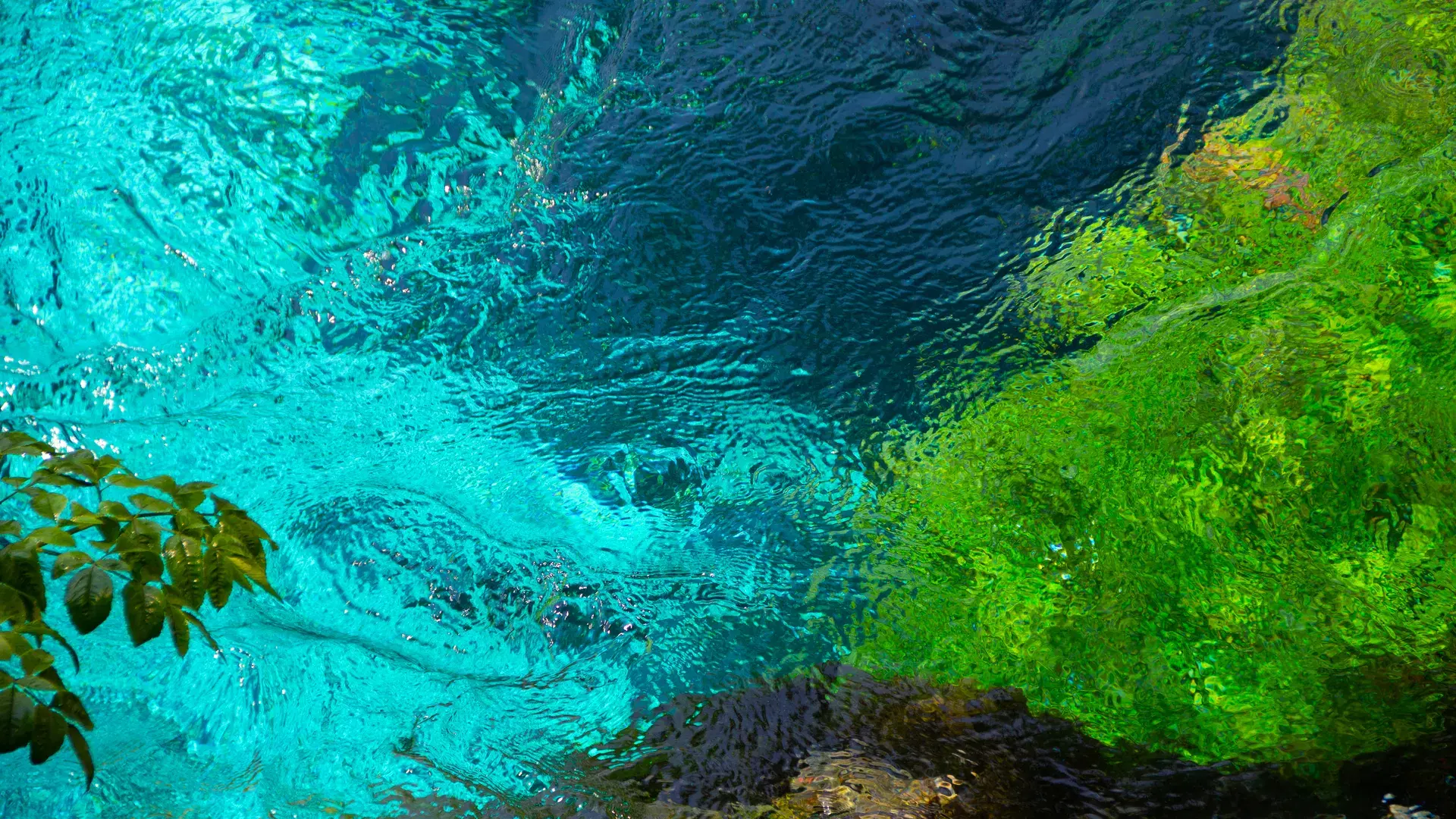
What is the Blue Eye?
It is the largest of 18 karst springs that burst out at the foot of Mali i Gjerë, the limestone ridge east of Sarandë. The National Agency of Protected Areas (AKZM) puts its average flow at 6 m³/s; all the springs together release 17.7 m³/s, and this is where the Bistricë river begins.
The water rises from below instead of falling from above, so the surface looks as if it were simmering. AKZM describes a round 'eye' about 10 m across, with a blue-black 'pupil' where the shaft drops away and a ring of lighter blue where the water is shallower.
Albania's National Tourism Agency (AKT) says the water emerges from a depth of more than 45 m. Downstream, the river ends in the reservoir of the Bistrica hydropower plant.
Where is it, and which road leads there?
The spring lies by the village of Muzinë, facing Krongj across the valley, about 18 km from Sarandë according to AKT.
AKZM places it on the western foot of Mali i Gjerë, 70 m–100 m above sea level, next to the national road that joins Gjirokastër, Delvinë and Sarandë. The park belongs to the municipality of Finiq, in Vlorë county.
We haven't found an official public transport timetable to the spring, so we don't publish one. From the coast it fits into a morning or an early afternoon, which leaves the evening for Sarandë after dark.
Can you swim in the Blue Eye?
We can't give you an official rule either way: AKZM's page for the park publishes no bathing rule, and we found none from the park administration that we could check.
What the agency does describe is reason enough for care. The water is cold, it surges up through a vertical shaft fed by a horizontal gallery inside the mountain, and the spring sits within a protected natural park. On site, follow what the park staff tell you.
Why is the Blue Eye protected?
Because of the spring and the forest that grows on its water: AKZM ranks it among the most important sites of its category. Its protection has been widened once, and the table shows both decisions.
Day-to-day management belongs to the Protected Areas Administration of Vlorë (AdZM Vlorë), under AKZM. The agency's ID card for the site, filled in in September 2019, counted 106,569 visitors.
| Council of Ministers decision | Status | Protected area |
|---|---|---|
| No. 102 of 15 January 1996 | Natural monument (category III) | 180 ha |
| No. 60 of 26 January 2022 | Natural park (category IV) | 293.30 ha |
What lives around the spring?
Old oriental plane trees and several oaks, Turkey oak and Hungarian oak among them, shade the water. In places the undergrowth is so dense that AKZM calls it a real jungle.
Recent surveys recorded a bat new to Albania, Bechstein's bat (Myotis bechsteini). Queen Olga's snowdrop (Galanthus reginae-olgae) and more than 30 species of orchid grow in the park, and the otter (Lutra lutra) is the key species on the site's ID card.
Visitors still throw coins into the spring for luck. AKZM links the habit to ancient rites at springs near Phoenice and Butrint.
When is the Blue Eye busiest?
In summer: AKT counts it among the most visited sights in the south of the country, especially in that season.
The spring itself barely changes through the year, since AKZM describes an almost regular flow. Summer is also fire season here: after the fires of August 2025, the agency's inspection on 14 August 2025 estimated 30.66 ha burned inside the park.
From the spring back to a night on the coast
The Blue Eye is a daytime outing; the nights happen by the sea. Our comparison of Saranda or Ksamil for a night out helps you pick the town, and the calendar of nights lists them with their dates.
The programme for summer 2027 hasn't been published yet. When it is, it will appear on our 2027 page.